How to Find Product Ideas from Amazon Reviews and Reddit Complaints
- Share
- publisher
- RND Sourcing Team
- Issue Time
- Aug 21,2026
Summary
A Yiwu sourcing team explains how to mine Amazon 1-3 star reviews and Reddit complaints for unmet needs, cluster the pain by frequency, mine competitor Q&A, and translate complaints into a buildable product spec.

How to Find Product Ideas from Amazon Reviews and Reddit Complaints
The cheapest, most honest product research in the world is already written — by angry customers. Every 1-star Amazon review and every Reddit rant is a person who wanted to give a company money and was let down. At RND Sourcing we have built entire import catalogs by simply reading what people hate about existing products. This post is the method we use: mine the complaints, cluster them, and turn the pain into a spec.
Negative Reviews Are Free Market Research
A happy customer writes 'great product.' An unhappy customer writes three paragraphs explaining exactly what failed and why. That detail is gold. Negative reviews are not noise to filter out; they are a pre-paid focus group describing the gap your product should fill. The only cost is the time to read and organize them.
Complaints are a gift you did not pay for
Someone else's returned product is your product brief. Before brainstorming from a blank page, mine what already exists. Our market-gap formula sizes the opportunity behind each complaint cluster.
Why Complaints Beat Brainstorms
Brainstorming produces what you think people want. Complaints reveal what people have already paid for and been disappointed by — proven demand with a known defect. A brainstorm asks 'what should we build?'; a complaint file answers 'what should we fix?' The second question has a customer attached to it.
Step 1 — Mine Amazon 1-3 Star Reviews
Start with the category you understand or want to enter. Pull the 1-3 star reviews for the top 10-20 products, aiming for 300-500 reviews per product family. Export with a tool like Helium 10 or Jungle Scout, or read manually. Filter to low-star only — that is where the unmet need lives. Save each complaint as a single tagged sentence.
- Target the top sellers in your category, not obscure listings.
- Pull 300-500 low-star reviews to avoid one-off gripes.
- Tag each complaint with a short pain keyword (leaks, brittle, smells).
- Keep the 4-5 star reviews too — they tell you what NOT to change.
Clustering by Frequency: The 80/20 of Pain
Raw complaints are noise until you cluster them. Group every tagged sentence by root cause: 'lid leaks at seam,' 'handle snaps under load,' 'hard to clean inside.' Then count. The clusters that appear in 15-30% of reviews are your priority — they are frequent enough to be a real market and specific enough to design against. This frequency ranking is the 80/20 that turns venting into a roadmap.
Step 2 — Mine Reddit Complaints
Amazon tells you what is wrong with a product; Reddit tells you what is wrong with a whole category and what people wish existed. Search subreddits relevant to your niche for phrases like 'frustrated with,' 'why does every,' and 'wish there was.' Our deeper dive into Reddit 'wish there was a…' threads shows how to harvest unbuilt-product wishes directly.
- Search niche subreddits, not just r/AskReddit.
- Use phrases: 'wish there was,' 'why is no one,' 'frustrated with.'
- Note the upvotes — high-karma complaints signal many people agree.
- Cross-check that the pain is unserved, not just under-served.
Step 3 — Mine Competitor Q&A and 'Wish' Threads
Amazon's 'answered questions' section is an underused goldmine. Unanswered questions like 'is it dishwasher safe?' or 'does it fit a 40oz bottle?' are gaps the current product does not close. On Reddit and niche forums, 'wish' threads list products people would buy today if they existed. Each unanswered question is a feature your product should ship with.

From Complaint to Concept: The Translation
Each high-frequency cluster becomes a line in your spec. The translation is mechanical once the clusters are clear: a complaint about leaking lids becomes 'welded, leak-proof seam with a 12-month guarantee'; a complaint about breakage becomes 'reinforced nylon hinge rated for 5,000 open-close cycles.' You are not inventing — you are finishing what the market started.
| Recurring complaint | Translated spec line |
|---|---|
| Lid leaks at the seam | Ultrasonic-welded seam, leak-proof certified |
| Handle snaps under load | Glass-fiber reinforced hinge, 5k cycle rated |
| Impossible to clean inside | Wide-mouth + disassemblable core |
| Cold drink warms in 1 hour | Triple-wall vacuum, 24h cold claim |
| Cheap feel, scratches | Bead-blasted 304 steel, scratch-resistant |
A Real Mining Example (Walkthrough)
We mined travel mugs: 412 low-star reviews clustered into 'lid leaks' (28%), 'doesn't stay cold' (19%), 'handle breaks' (14%). Reddit added 'never fits cup holders.' The resulting spec was a triple-wall, welded-seam mug with a cup-holder-compatible base and a reinforced hinge — every feature traced to a numbered complaint. That discipline is why the product pre-sold 1,800 units before tooling.
Common Mistakes in Review Mining
Most people who 'read reviews' learn nothing because they commit one of these errors. Avoid them and your shortlist will be far stronger than a competitor's gut feel.
- Reading only the top 10 reviews instead of hundreds.
- Ignoring 4-5 star praise — you still must keep what works.
- Mining too small a sample and over-weighting one rant.
- Copying the competitor instead of fixing the root cause.
- Forgetting compliance — a 'fix' that breaks a safety standard is not a fix.
How RND Turns Complaints Into Shortlists
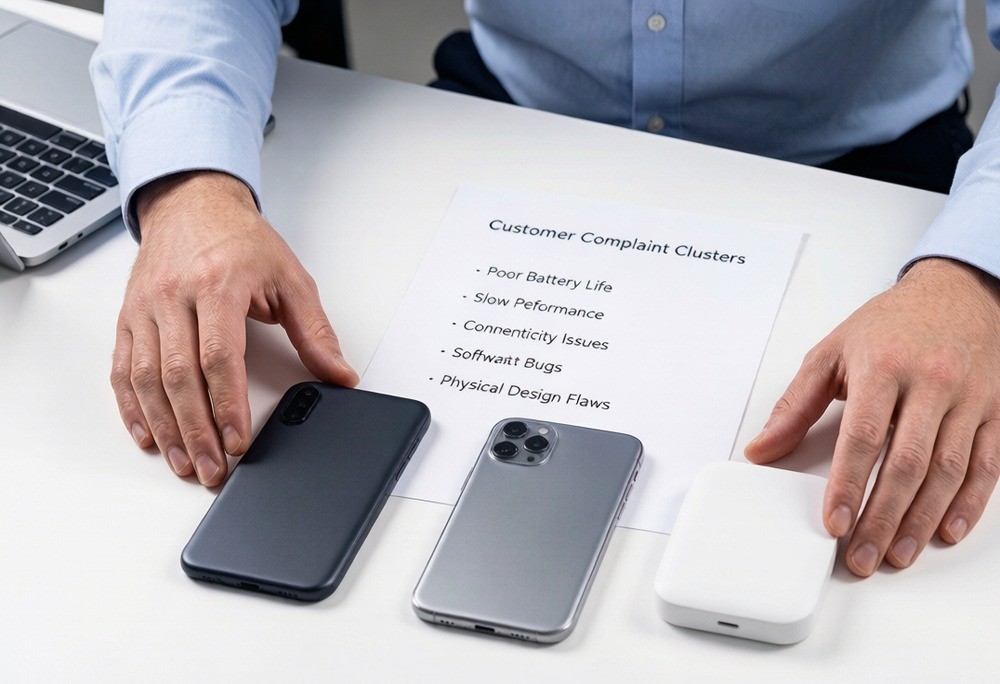
When a client wants a new product, we do not start with ideas — we start with a complaint file. RND Sourcing Team mines Amazon and Reddit for the target category, clusters the pain by frequency, translates the top clusters into a spec, then sources Yiwu and Delta factories against that spec. The result is a product brief backed by thousands of real customer sentences, not a founder's hunch.
Conclusion: Mine Before You Imagine
The next product idea is not in your head; it is in the 1-star reviews and Reddit threads of the category you already care about. Mine Amazon low-star reviews, cluster the pain by frequency, harvest Reddit complaints and competitor Q&A, then translate each cluster into a spec line. Do that and you will never launch a product nobody asked for. To have RND mine your category and build the shortlist, contact our sourcing team and we will start from the complaints, not the blank page.
How do I find product ideas from Amazon reviews?
Pull the 1-3 star reviews for the top 10-20 products in a category (300-500 reviews), tag each complaint with a pain keyword, then cluster by frequency. The clusters appearing in 15-30% of reviews are proven, specific unmet needs worth building for.
Are Reddit complaints good for product research?
Yes. Reddit reveals category-level frustration and unbuilt wishes that Amazon reviews miss. Search niche subreddits for 'wish there was,' 'frustrated with,' and 'why does every,' and weight complaints by upvotes to gauge how many people agree.
What are Amazon answered questions good for?
Unanswered questions like 'is it dishwasher safe?' expose gaps the current product does not close. Each becomes a feature your product should ship with, and a differentiator in your listing.
How many reviews should I mine before deciding?
Aim for 300-500 low-star reviews per product family across the top sellers. Fewer and you over-weight one-off gripes; more and the frequency pattern stops changing. Cluster, then translate the top clusters into spec lines.
Stop guessing and start reading. The complaints are already written; your job is to cluster them and build the fix. Ask RND Sourcing to mine your category and turn thousands of angry reviews into one product brief worth manufacturing.