What duties and taxes apply when importing from China to the US?
- Share
- Issue Time
- Aug 20,2026
Direct Answer
For US imports from China, the duty is a stack on top of the product price: the base HTS (Column 1-General) rate, any Section 301 additional tariff (typically 7.5% to 25%, and far higher on strategic goods), plus a Merchandise Processing Fee of 0.3464% (minimum $32.71, maximum $634.62 per entry) and a Harbor Maintenance Fee of 0.125% on ocean shipments, and your state may add a sales or use tax. RND SOURCING models the full duty stack on every quote so the landed number you see is the number you pay.
Detailed Explanation: The Duty Stack
US Customs (CBP) values the goods at the transaction price, then layers fees on top. The headline HTS rate is only the first layer — the surprises are the ones below it.
The 10% Section 122 universal surcharge that applied from 2025 expired on 24 July 2026, so today's stack is the base rate, Section 301, MPF, HMF, and any state sales or use tax. Each layer is calculated on the customs value, so they compound.
- Base HTS rate The Column 1-General (MFN) rate for your 10-digit HTS code; many lines are 0%.
- Section 301 tariff Additional duty on Chinese origin since 2018: 7.5% to 25%, up to 100% on EVs and solar.
- MPF + HMF Merchandise Processing Fee 0.3464% (min $32.71 / max $634.62); Harbor fee 0.125% on ocean.
- State sales / use tax Levied by your state on imported goods; varies by destination and use.

Real-World Example: The $10,000 Furniture Order
A US home-goods buyer quoted $10,000 FOB for wooden furniture (HTS 9403.60, base MFN rate 0%) and budgeted only the product cost. RND SOURCING modeled the full stack on a formal ocean entry: base duty $0, Section 301 List 3 at 25% = $2,500, MPF 0.3464% = $34.64, HMF 0.125% = $12.50.
The supplier's quote had hidden the 25% China tariff. The buyer entered the order knowing the true $2,547.14 duty bill instead of discovering it at the port.
Key Data: The 2026 Fee Rates
These are the federal rates a China importer pays in 2026. State sales or use tax is additional and set locally.
Section 301 rates range from 7.5% (List 4A) to 25% (Lists 1-3), with targeted 50% on solar/syringes and 100% on EVs. Confirm the exact 10-digit HTS with a licensed broker.
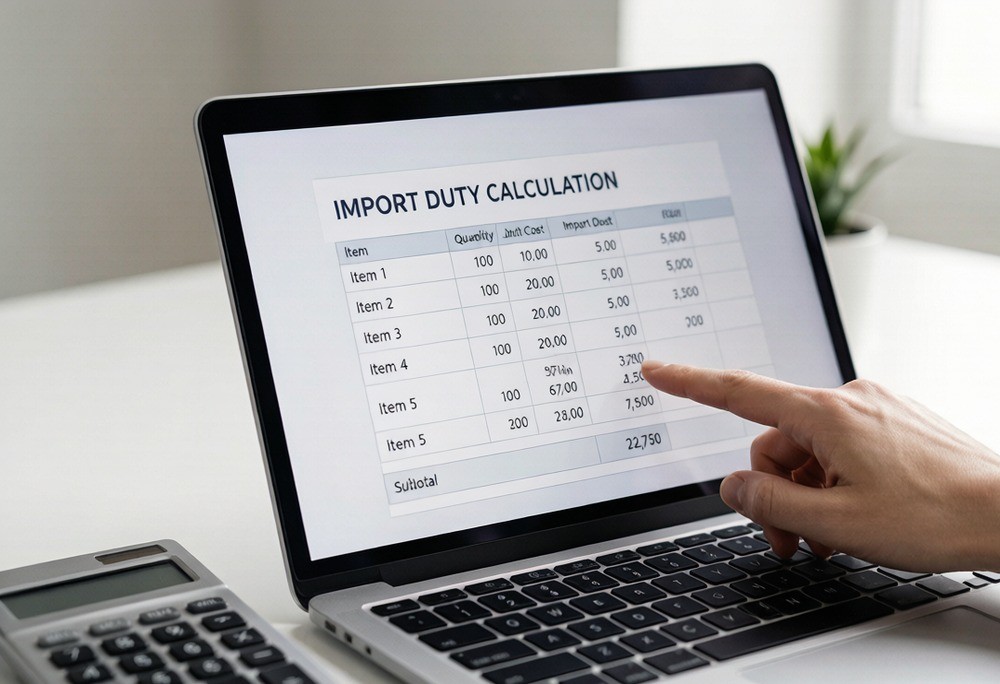
Step-by-Step: Estimate Your Import Duty
Run this before you agree a supplier price.
Get the 10-digit HTS
Classify the product precisely; the rate is set at the 10-digit level.
Look up the base rate
Read the Column 1-General (MFN) rate for that code.
Add Section 301
Check which 301 list the code falls under and add the surcharge.
Add MPF and HMF
0.3464% MPF (with min/max) plus 0.125% HMF if it arrives by sea.
Add state tax
Include your state's sales or use tax on the imported value.
Common Mistakes That Inflate the Bill
These are the duty errors RND SOURCING flags most often.
- Budgeting only the base rate Ignoring Section 301 can hide 25% of the product value.
- Using a 4-digit HS guess Rates differ sharply at the 10-digit level; guess wrong and you underpay or overpay.
- Forgetting HMF on ocean Air or land crossings skip HMF, but most China containers owe it.
- Ignoring state use tax The federal stack is not the end; your state adds its own layer.

How RND SOURCING Protects You
RND SOURCING builds the full duty stack — base HTS, Section 301, MPF, HMF, and estimated state tax — into every China quote, so you price against landed cost, not factory price. We flag 301 exposure by HTS before you commit and connect you with a licensed broker for the final entry.
You walk into customs knowing the exact number, not hoping for the best.
Get a landed-cost quote from RND SOURCINGRelated Questions
- Who is responsible for customs clearance and freight under different Incoterms?
- How can I verify a Chinese supplier's business license and avoid scams?
- When should I hire a China sourcing agent, and who should pay them?
- What quality control steps should a China order include?
- How do I calculate the true landed cost of a China import?