Sustainable Sourcing from China: Eco-Friendly Products and Green Manufacturing
- Share
- publisher
- RND Sourcing Team
- Issue Time
- Aug 10,2026
Summary
A practical guide to sourcing sustainable products from China, covering eco-materials, green certifications, packaging waste, and the true cost of going green.

Sustainable Sourcing from China: Eco-Friendly Products and Green Manufacturing
Sustainable products are no longer a niche; they are a buying criterion. At the 137th Canton Fair in 2025, green goods dominated, from bagasse (sugarcane fibre) tableware to ribbons made of 50% recycled plastic bottles, with suppliers holding FSC, GRS, OEKO-TEX, and GOTS certifications (Workercn, 2025). The EU's Carbon Border Adjustment Mechanism (CBAM) is also raising the compliance bar. This guide shows how to source eco-friendly products from China without falling for greenwashing. Our RND Sourcing team helps buyers verify real sustainability on the ground in Yiwu.
The Rise of Sustainable Consumer Demand
Shoppers in the EU and North America increasingly filter by environmental claims, and regulators are catching up. The EU CBAM now requires carbon accounting on imports, and major retailers demand traceability. Chinese exporters have responded: at the 2025 Canton Fair, Zhejiang Zhongxin Eco-Tech secured over USD 580,000 in intent orders for bagasse tableware, while Huzhou Beheng won deals for recycled polyester ribbon used by ZARA and IKEA (Workercn, 2025).
Identifying Eco-Friendly Suppliers
Green claims are easy to make and hard to verify, so screen suppliers by evidence, not slogans. Look for recognised third-party certifications, a documented material traceability chain, and the factory's own environmental permits. A reputable eco-supplier will show you the certificate number and the audit scope, not just a logo on a brochure.
- Valid third-party certifications with checkable numbers.
- Material traceability from source to finished good.
- Factory environmental permits and energy data.
- Willingness to allow an on-site audit.
Verify, don't trust
Certificates can be forged or out of scope. RND checks the issuing body and audit date before listing a supplier as eco-friendly. Ask us to verify a factory.
Sustainable Materials: Bamboo, Recycled Plastics, Organic Cotton
Three material families lead China's eco shift. Bamboo grows fast with low inputs and is used for textiles, tableware, and packaging; global bamboo apparel is projected to reach USD 21 billion by 2028. Recycled PET (rPET) turns plastic bottles into fibres and ribbons. Organic cotton avoids synthetic pesticides but needs certification to be credible. Each has trade-offs in cost and supply, which your agent should map.
| Material | Eco benefit | Watch-out |
|---|---|---|
| Bamboo | Fast renewable, low inputs | Processing chemistry varies |
| Recycled PET | Diverts plastic waste | Food-contact rules apply |
| Organic cotton | No synthetic pesticides | Needs GOTS proof |
Green Certifications: FSC, GOTS, OEKO-TEX
Certifications are the proof layer, but they measure different things. FSC certifies responsibly sourced wood and bamboo fibre. GOTS requires 70% (label 'made with organic') or 95% (full label) certified organic fibres across the whole production process, making it hard to fake. OEKO-TEX Standard 100 tests finished textiles for about 100 harmful substances, so it is a chemical-safety mark, not a full environmental claim (Maxam Group, 2025). Know what each certificate actually verifies before you cite it.
- FSC: responsible forestry and bamboo fibre sourcing.
- GOTS: strict organic fibre content and full-process criteria.
- OEKO-TEX Standard 100: chemical safety, not environmental performance.
- GRS: recycled content verification for rPET and similar.

Reducing Packaging Waste
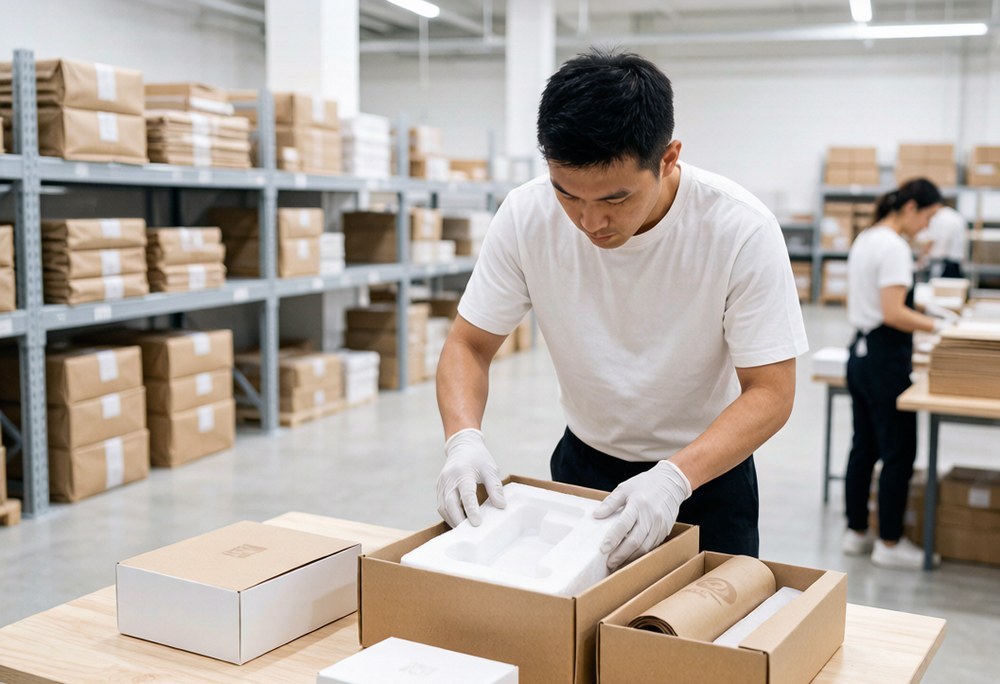
Packaging is where much avoidable waste hides. At the 2025 Shanghai East China Fair, over 80% of gift exhibitors used biodegradable packaging, some offering zero-plastic displays (EastChinaFair, 2025). Specify recycled or compostable mailers, right-size cartons to cut void fill, and ask suppliers to skip unnecessary inner boxes. Smaller, lighter packaging also lowers freight emissions and CBAM exposure.
Specify material
Require recycled or compostable packaging in the brief.
Right-size
Match carton to product to cut void fill.
Consolidate
Remove redundant inner boxes where safe.
Case Study: Sustainable Product Line Sourced by RND
A North American home-goods client wanted an eco picnic line. RND shortlisted Yiwu-cluster suppliers and verified FSC certification for bamboo fibre and GRS for recycled cutlery trays. We rejected one factory whose 'biodegradable' claim lacked a valid certificate, then consolidated samples to our warehouse for a side-by-side review. The approved line shipped with documented FSC and GRS certificates, giving the client defensible green claims for the EU market.
Cost Implications of Green Sourcing
Going green usually costs more at the unit level, but the maths is shifting. Certified firms in China gained tariff cuts (FSC-certified Yunnan exporters saw a 2.7-point German tariff reduction), price premiums (GOTS bamboo products sold at 1.8x cotton prices), and green-loan subsidies up to 30% (Unitex, 2025). For many brands, the premium is recovered through higher retail prices and lower compliance risk under CBAM.
Total cost view
Eco materials may raise unit cost 10-30%, but certifications can cut tariffs and unlock premiums that exceed the gap. Model landed cost, not just factory price.
How RND Can Help You Source Sustainably
RND Sourcing treats sustainability as a verification task, not a marketing label. We screen suppliers for real certifications, consolidate eco-samples for efficient review, and brief inspectors to check material claims against documents. With 20+ years in Yiwu and a vetted network, we connect you to factories that can prove, not just promise, their green credentials, with transparent flat fees.
- Certification verification against issuing bodies.
- Eco-sample consolidation to cut freight and waste.
- Material-claim checks during independent inspection.
- Vetted green-manufacturing network in Yiwu clusters.
Conclusion
Sustainable sourcing from China is practical when you verify claims with certificates and audits rather than brochures. Bamboo, recycled plastics, and organic cotton are mature options, and FSC, GOTS, and OEKO-TEX give you defensible proof, if you know what each measures. The cost gap is narrowing through tariffs and premiums. To build a credible eco product line, send us your requirements and we will verify green suppliers on the ground.
What does OEKO-TEX actually certify?
OEKO-TEX Standard 100 tests finished textiles for about 100 harmful substances. It is a chemical-safety mark, not proof of low environmental impact during production.
Is bamboo truly sustainable?
Bamboo is a fast-renewing, low-input crop and a strong eco choice, but its sustainability depends on the processing chemistry, so verify the full production claim.
Do green certifications reduce my import costs?
Sometimes. Certified Chinese exporters have won tariff cuts and price premiums that can offset higher unit costs, especially in the EU.
How can I avoid greenwashing when sourcing?
Require checkable third-party certificates (FSC, GOTS, GRS), verify the issuer and audit date, and confirm material traceability before ordering.
Real sustainability is verified, not claimed. Contact RND Sourcing to build a certified, audit-backed eco supply chain from Yiwu that survives scrutiny.
Sources & Further Reading
According to Yiwu Customs (2025) annual import/export bulletins and two decades of hands-on sourcing at RND Sourcing, the steps and figures above reflect current market practice. Before you commit budget, verify the details against the primary sources:
Official trade data — Yiwu Customs and your national customs authority publish yearly import/export statistics.
Product & safety standards — ISO 9001 for quality systems, plus the marks your market requires (CE for the EU; FCC/UL for the US; CPSC/FDA where applicable).
Supplier verification — third-party factory audits and inspection records, not only the supplier's own claims.
Figures follow the most recent published period; regulations shift, so confirm with the relevant authority before placing an order.
Work With RND Sourcing
RND Sourcing is your on-the-ground sourcing team in Yiwu, helping global buyers find reliable factories, negotiate better terms, and ship with confidence. For a free, no-obligation consultation, visit yourchinagent.com.